
Veneer and laminate look similar in a showroom sample and behave very differently after five monsoons and five Delhi summers. If you are specifying doors for a home in the NCR, the climate here — 45°C dry heat, then months of high humidity — will test the finish harder than the design. Here is how each material actually ages, and where each one is the right call.
What you are actually comparing
Veneer
Veneer is a thin slice of real wood, typically 0.5mm to 4mm thick, bonded to a substrate such as plywood or MDF. The surface you see and touch is genuine timber, with real grain that varies sheet to sheet. It is finished on site or in the factory with a coat of melamine, PU or polyurethane lacquer, and that top coat — not the wood — does most of the protecting.
Laminate
Laminate is a manufactured sheet: layers of kraft paper impregnated with resin, topped with a printed decorative layer and a clear wear layer, all pressed under high heat. The result is a hard, sealed, dimensionally stable surface that is finished the moment it leaves the factory.
How each one handles NCR weather
Heat and direct sunlight
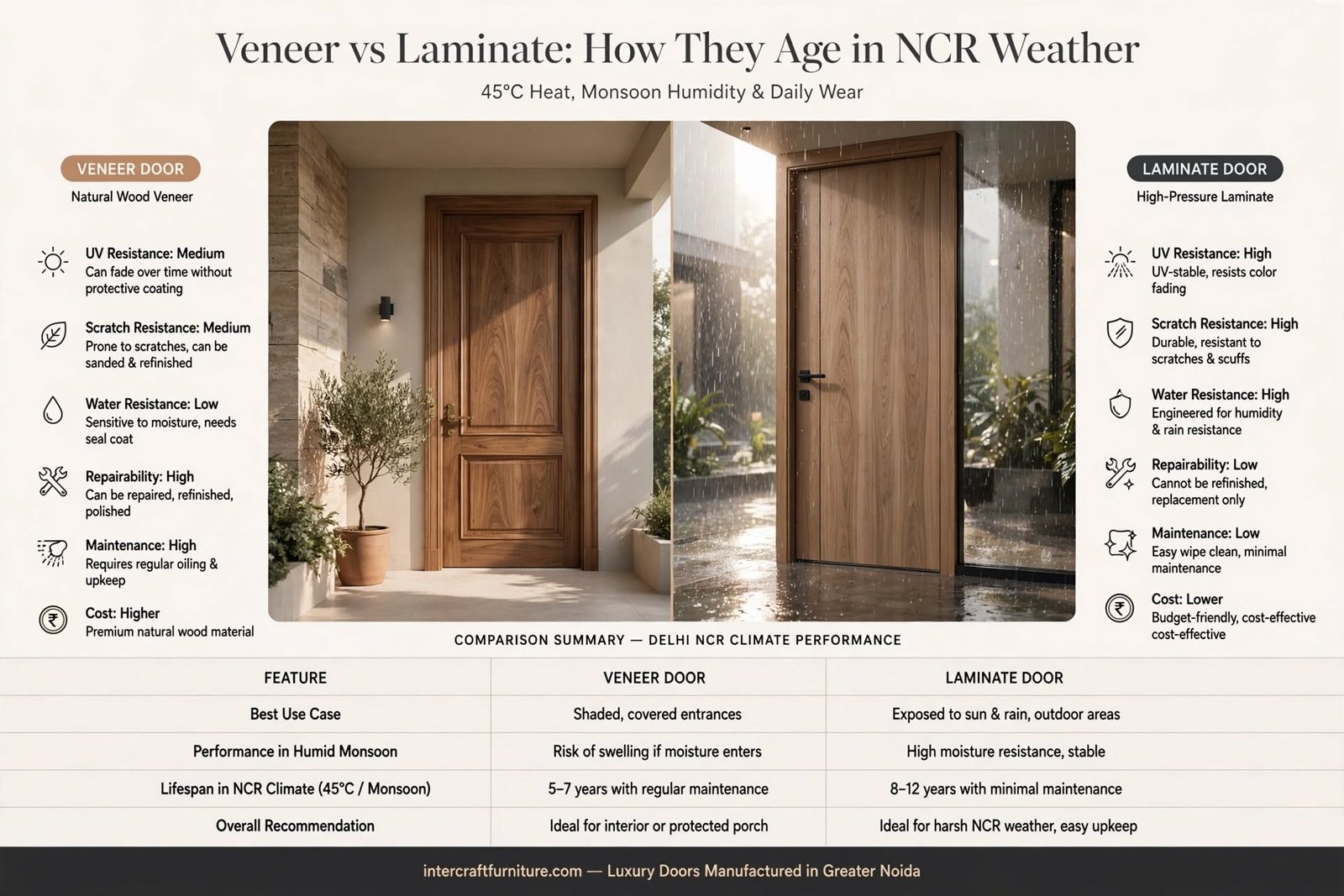
This is where veneer suffers most. A main door facing west takes hours of hard afternoon sun, and UV exposure will fade and yellow a veneer finish over time. The lacquer degrades first, then the wood underneath darkens unevenly. High-pressure laminate holds its colour far better under the same exposure.
Humidity and monsoon
Both materials are vulnerable, but at different points. Laminate is essentially waterproof across its face — water sits on it and wipes off. Its weakness is the edges and joints, where moisture can creep behind the sheet and cause it to lift or delaminate. Veneer, being real wood under a coat, can absorb moisture through any break in the finish and will swell or blister where that happens.
Daily wear
Laminate is significantly harder. It resists scratches, keys, cleaning cloths and the general abuse a main door takes. Veneer scratches more easily, and a deep scratch exposes bare wood.
Direct comparison
| Factor | Veneer | Laminate |
|---|---|---|
| Surface material | Real wood | Printed resin sheet |
| Appearance | Natural, non-repeating grain | Consistent, pattern repeats |
| UV / fading resistance | Moderate — fades over years | High |
| Scratch resistance | Lower | High |
| Water resistance | Depends on top coat | High on face, weak at edges |
| Repairability | Can be sanded and refinished | Cannot be repaired — replace the sheet |
| Maintenance | Needs periodic re-polishing | Essentially none |
| Cost | Higher | Lower |
| Feel and perceived quality | Warmer, premium | Functional |
The repairability point that changes the calculation
Laminate outlasts veneer on most measures except one that matters a great deal over a twenty-year period: veneer can be restored. Scratched, dulled or sun-faded veneer can be lightly sanded and re-polished, and it comes back looking close to new. Damaged laminate cannot be repaired at all — a delaminated corner or a gouge means replacing the entire sheet, which usually means replacing the door face.
So the honest framing is not “which lasts longer” but “which failure are you willing to live with”. Laminate degrades slowly and then needs replacing. Veneer degrades faster but can be renewed several times.
Where to use each
Choose veneer for
- Main entrance doors under a covered porch or lobby, where the door is protected from direct sun and rain but is the first thing guests see
- Internal doors in bedrooms and studies, where wear is light and warmth of material matters
- Feature wall panelling and designer door faces where the natural grain is the point
- Any door you want to keep for decades and are willing to re-polish
Choose laminate for
- Doors with direct sun exposure — west and south-facing entrances without shade
- Bathroom and utility doors, where humidity is constant
- Kitchen doors and high-traffic internal doors
- Children’s rooms and rental properties, where scratch resistance and zero maintenance win
- Offices and commercial spaces with heavy daily use
Two details that matter more than the material choice
Edge sealing. Whichever you pick, the edges decide the lifespan. On a laminate door, unsealed edges let moisture behind the sheet. On a veneer door, unsealed edges let moisture into the substrate. Every edge — including the top edge you never look at — should be banded and sealed.
The top coat on veneer. Veneer’s durability is almost entirely a function of its finish. A PU coat outperforms basic melamine substantially in both UV and moisture resistance. If a quotation says “veneer finish” without naming the top coat, that specification is incomplete.
Frequently asked questions
Is veneer worth the extra cost?
For a protected main door or feature panelling where appearance is the priority, yes — nothing printed matches real grain. For a bathroom door, no.
How often does veneer need re-polishing?
Depending on exposure, roughly every five to eight years for interior doors. Sun-exposed veneer needs attention sooner.
Can laminate look like real wood?
Modern high-pressure laminates get close, with textured surfaces that follow the printed grain. Up close the repeat pattern is still detectable, but for most applications the difference is minor.
Which is better for a main door in Delhi NCR?
If the door gets direct afternoon sun and rain, laminate. If it sits in a shaded porch or an internal lobby, veneer with a PU top coat is the better-looking choice and will age well.
Specifying your doors
The right answer depends on orientation, exposure and how each door will be used — which is why a single specification across an entire home is rarely correct. Intercraft Furniture manufactures luxury doors in both veneer and laminate finishes at its Greater Noida facility, made to your opening sizes. To discuss a specification for your project, visit intercraftfurniture.com.