

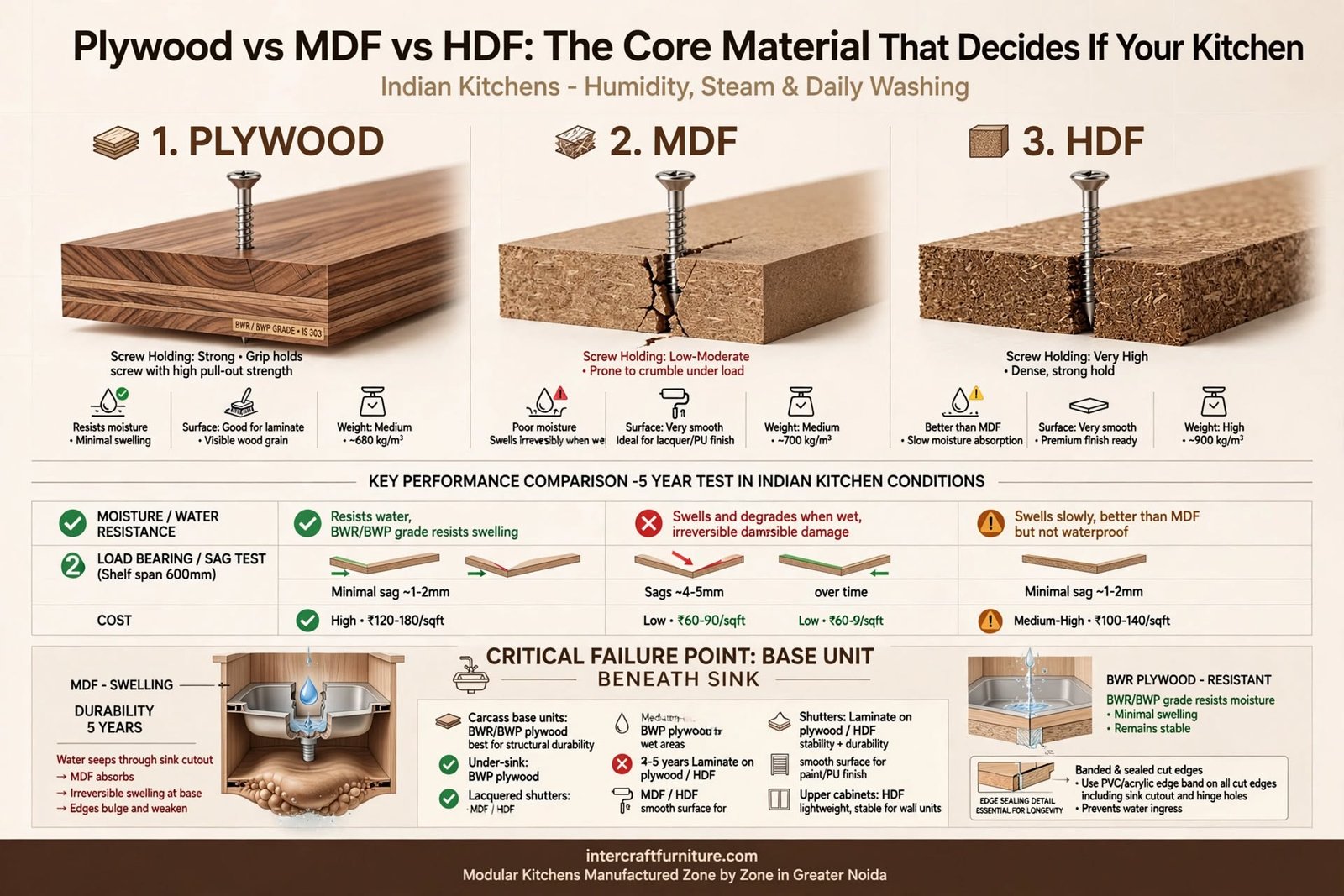
Almost every modular kitchen quotation you receive will list a core material — plywood, MDF or HDF — and most buyers accept whatever is written without knowing what the difference means five years later. In an Indian kitchen, where humidity, steam and daily washing are constant, this single choice decides whether your cabinets stay square or start swelling at the base. Here is what each material actually is, and where each one belongs.
What these materials are
Plywood
Plywood is made from thin sheets of real wood veneer stacked in layers, with the grain of each layer running perpendicular to the one below and bonded under heat and pressure. That cross-grain construction is what gives plywood its strength — it resists bending and holds screws firmly because there is continuous wood fibre running through it.
MDF (Medium Density Fibreboard)
MDF is engineered from wood fibres broken down into pulp, mixed with resin and compressed into a uniform panel. It has no grain and no voids, which makes it exceptionally smooth and dimensionally consistent — ideal for painted and lacquered finishes where any grain telegraph would show.
HDF (High Density Fibreboard)
HDF is made the same way as MDF but compressed harder, producing a denser, heavier and stronger panel. It sits between MDF and plywood on strength, and takes a very hard, flat surface.
The comparison that matters
| Property | Plywood | MDF | HDF |
|---|---|---|---|
| Screw holding | Excellent | Weak — strips under load | Moderate |
| Moisture behaviour | Good, best in BWR/BWP grade | Poor — swells and stays swollen | Better than MDF, still vulnerable at edges |
| Surface smoothness | Grain may telegraph | Excellent | Excellent |
| Weight | Lighter | Heavy | Heaviest |
| Load bearing over span | Strong, minimal sag | Sags over long spans | Moderate |
| Cost | Highest | Lowest | Mid |
| Best use in a kitchen | Base units, carcass, anything near water | Shutters with lacquer or paint finish | Shutters, back panels, upper units |
Why moisture is the deciding factor in Indian kitchens
The failure point in almost every kitchen is the same: the base unit beneath the sink. Water gets in through the sink cutout, through a loose pipe joint, or simply from mopping. Plywood in a boiling-water-resistant grade handles that exposure. MDF does not — once water enters the fibre, the panel swells irreversibly. You cannot dry it back to shape, and the swelling usually shows as a bulge at the bottom edge of the shutter or a soft, crumbling carcass base.
This is why a blanket “MDF kitchen” is a false economy in Indian conditions, while a blanket “everything in plywood” is often overspending on areas that never see water.
Understanding plywood grades
Not all plywood is equal, and the grade on the stamp tells you what it can survive:
- MR (Moisture Resistant): Handles ambient humidity, not direct water. Suitable for bedroom wardrobes, not for kitchen base units.
- BWR (Boiling Water Resistant): Bonded with phenolic resin. This is the practical standard for kitchen carcasses.
- BWP (Boiling Water Proof) / Marine: The highest resistance. Appropriate under the sink and in any area with regular direct water contact.
Ask which grade is being supplied, and ask to see the stamp on the sheet. A quotation that says only “plywood” without a grade is not telling you anything useful.
The practical approach: mix by function
Experienced manufacturers rarely build an entire kitchen from one material. A sensible specification looks like this:
- Carcass, base units: BWR or BWP plywood. This is the structure that carries weight and sits closest to water.
- Under-sink unit: BWP plywood, with proper edge sealing on every cut edge.
- Shutters with laminate finish: Plywood or HDF both work well.
- Shutters with lacquered glass, PU or acrylic finish: MDF or HDF, because the perfectly flat surface is what makes a high-gloss finish look right.
- Upper cabinets away from water: HDF is a reasonable cost saving here.
The detail almost everyone ignores: edge sealing
Whatever the core, the material is at its most vulnerable at a cut edge. Every exposed edge should be banded and sealed — including the edges you never see, like the cutout around the sink and the drilled holes for hinges. An unsealed edge is an open door for moisture, and it is the single most common reason a kitchen that looked perfect at handover starts failing in year three.
Frequently asked questions
Is MDF always a bad choice?
No. For shutters with a lacquer, PU or acrylic finish, MDF gives a smoother, flatter result than plywood. The problem is using it for structural carcasses and wet zones, where it fails.
Does plywood guarantee the kitchen will not swell?
Only if the correct grade is used and the edges are properly sealed. MR grade plywood under a sink will fail much like MDF would.
Is HDF a good middle option?
For shutters and back panels, yes. For load-bearing base carcasses in a wet zone, plywood remains the safer specification.
How do I verify what I am actually getting?
Ask for the material grade in writing on your quotation, ask to see the sheet stamp before cutting begins, and check the edge banding on a finished sample. Any manufacturer confident in their material will show you all three.
Getting the specification right
The right combination depends on your kitchen layout, where the wet zones sit and what finish you want on the shutters. Intercraft Furniture manufactures modular kitchens in-house in Greater Noida and specifies materials zone by zone rather than applying one core across the whole kitchen. To discuss a specification for your kitchen, visit intercraftfurniture.com.