
Almost every modular kitchen quotation you receive will list a core material: BWP plywood, BWR plywood, HDF-HMR or MDF. The difference between them is not cosmetic. It decides whether your kitchen survives ten years of Indian humidity, water splashes and the occasional leaking pipe, or starts swelling at the base within two.
Here is what each one actually is, in plain terms.
What the “core” means
Every cabinet has two parts. The carcass is the box itself: the sides, base and shelves you do not really see. The shutter is the door on the front. The core material is what the carcass is made of, and it matters more than the finish, because the carcass is what sits closest to water.
BWP plywood
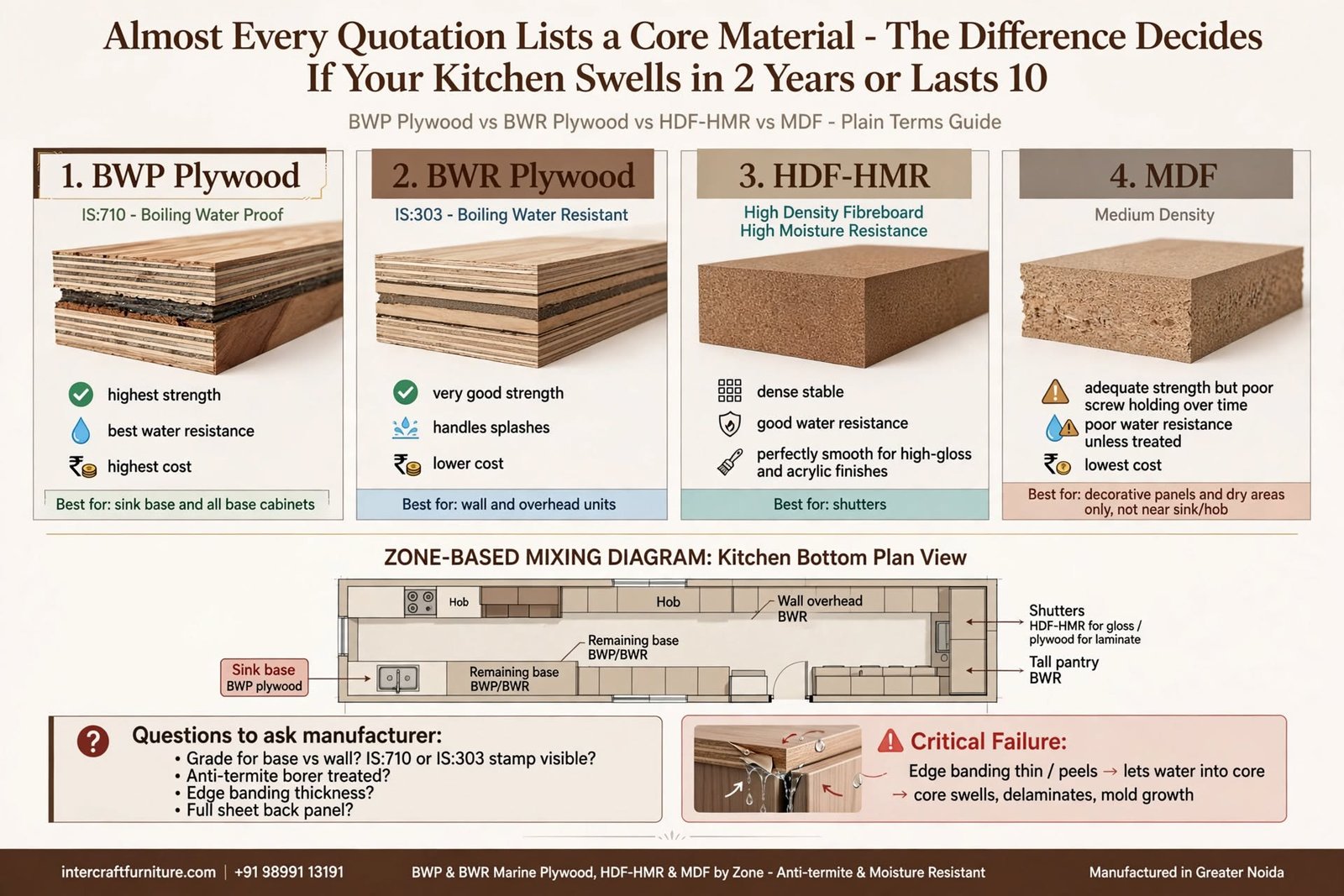
BWP stands for Boiling Water Proof. It is made from wood veneers bonded with phenol formaldehyde resin, the most water-resistant adhesive used in plywood.
- Strength: highest of the four. Holds screws and hinges firmly over many years.
- Water resistance: best. Survives standing water and steam better than anything else in this list.
- Cost: highest.
- Best for: the sink base unit, all base cabinets, and any kitchen you expect to keep for a decade or more.
Look for an IS:710 marking, which is the Indian Standard for BWP grade. Ask to see the grade stamp on the sheet rather than taking it on trust.
BWR plywood
BWR stands for Boiling Water Resistant. Same idea as BWP but a slightly less demanding standard, marked IS:303.
- Strength: very good.
- Water resistance: handles splashes and humidity well, but not prolonged standing water.
- Cost: lower than BWP.
- Best for: wall units and overhead cabinets, where water exposure is limited.
A common and sensible approach is BWP for base units and BWR for wall units. You spend the money where the water is.
HDF-HMR
High Density Fibreboard, High Moisture Resistance. Wood fibres compressed under high pressure with moisture-resistant resin.
- Strength: dense and very stable. Does not warp or develop gaps the way natural wood can.
- Water resistance: good, and better than ordinary MDF by a clear margin.
- Surface: perfectly smooth, which is why high-gloss and acrylic finishes sit better on it than on plywood.
- Cost: comparable to good plywood.
- Best for: shutters, especially where you want a flawless glossy finish.
MDF
Medium Density Fibreboard. Similar to HDF but less dense and usually without the moisture-resistant treatment.
- Strength: adequate but holds screws less well than plywood over repeated use.
- Water resistance: poor unless specifically treated. Standard MDF swells and does not recover once it absorbs water.
- Cost: lowest.
- Best for: decorative panels, shutters in dry areas, and budget builds where the base units are still plywood.
We would not recommend untreated MDF anywhere near a sink or hob.
A practical way to choose
Rather than picking one material for the whole kitchen, most well-built kitchens mix them by zone:
- Sink base and adjacent units: BWP plywood. This is where leaks happen.
- Remaining base units: BWP or BWR plywood.
- Wall and overhead units: BWR plywood.
- Shutters: HDF-HMR for gloss and acrylic finishes, plywood for laminate and veneer.
- Tall units and pantry: BWR plywood is usually enough.
A quotation that specifies material by zone is a good sign. One that just says “plywood” without a grade is worth questioning.
Questions worth asking your manufacturer
- Which grade is used for the base units, and which for the wall units?
- Is the plywood IS:710 or IS:303 marked, and can I see the stamp?
- Is the material anti-termite and borer treated?
- What edge banding is used, and how thick? Thin edge banding peels and lets water into the core.
- Is the back panel a full sheet or a thin backing board?
The last two matter more than people expect. A kitchen can have excellent core material and still fail early because the edges were sealed badly.
What we use
At Intercraft Furniture we build with BWP and BWR marine plywood, HDF-HMR and MDF depending on the zone and the finish you choose, all with anti-termite and moisture-resistant treatment. Your quotation states the grade for each part of the kitchen rather than a single blanket description, so you know exactly what you are paying for.
Talk to us about your kitchen: +91 98991 13191 or send an enquiry. You can also see our modular kitchen range and completed projects.