
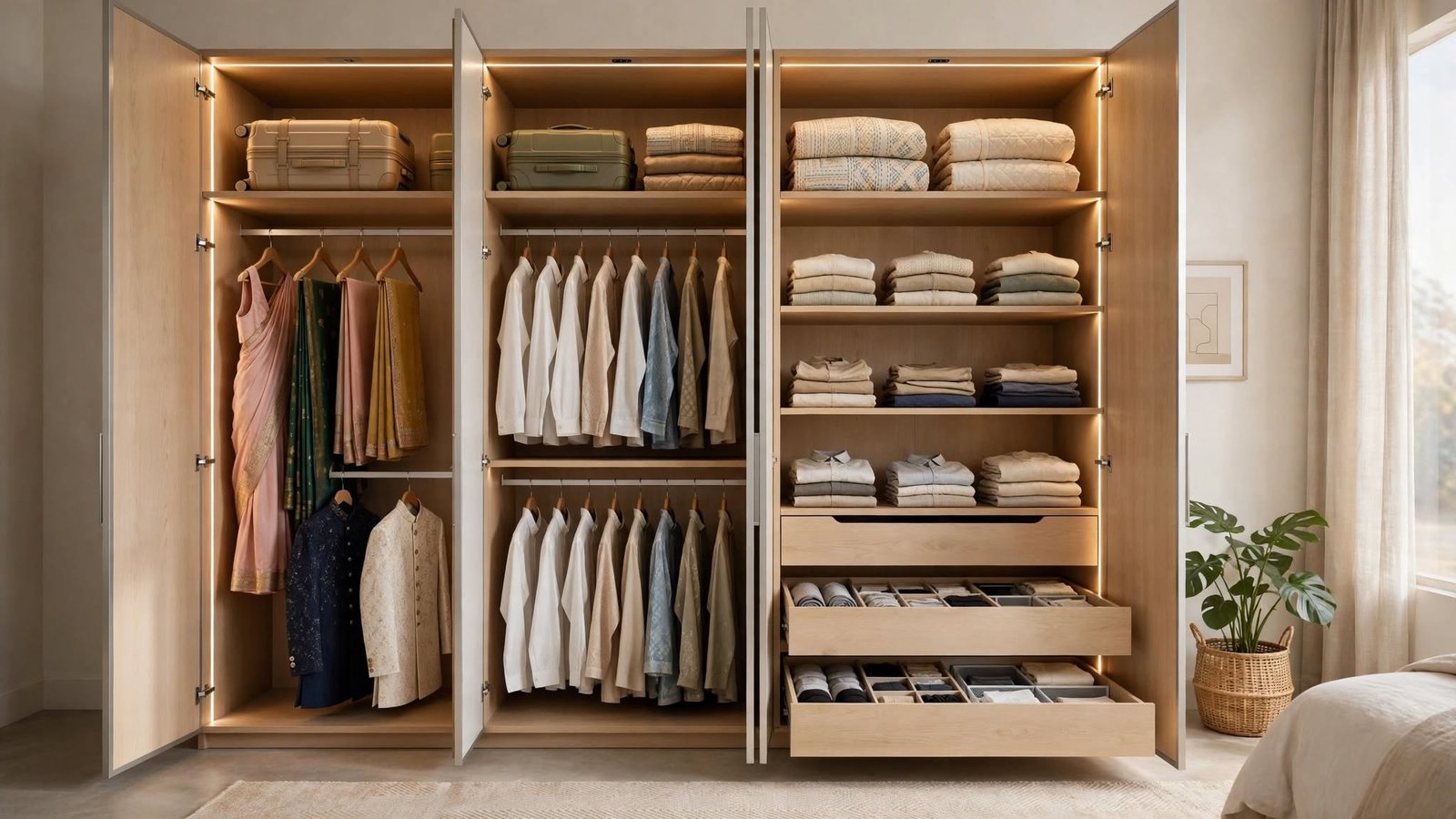
Most wardrobe conversations stop at the shutters. Sliding or hinged, laminate or acrylic, two-door or three-door. The part that decides whether you actually enjoy using the wardrobe every morning is the part nobody photographs: what happens inside it.
A badly planned interior is the reason you end up with a wardrobe that is technically full but has nowhere to put anything. Here is how to plan the inside before signing off a design.
Standard wardrobe dimensions to work from
Almost every internal decision hangs off three numbers.
| Dimension | Standard | Why |
|---|---|---|
| Depth | 22 to 24 inches | A shirt or kurta on a hanger needs about 21 inches; less than 22 and clothes press against the shutter |
| Height | Floor to ceiling | The top 18 inches becomes loft storage; stopping short creates a dust shelf |
| Shutter width | 18 to 24 inches per shutter | Wider hinged shutters sag over time and need a larger swing clearance |
If the room is tight and you are considering a 18 to 20 inch deep wardrobe, accept that full hanging will not work well. Either use sliding-out side hanger rods, or convert that section to shelves and drawers.
Start by counting what you own
This sounds tedious and it takes fifteen minutes. Count roughly:
- Long hanging items: sarees on hangers, sherwanis, long dresses, winter coats, anarkalis
- Short hanging items: shirts, kurtas, trousers, jackets, blouses
- Folded items: jeans, t-shirts, towels, bedsheets, woollens
- Small items: innerwear, socks, ties, belts, jewellery
- Bulk and seasonal: suitcases, quilts, off-season clothing
Then convert hanging items to running feet. Roughly 12 to 15 shirts occupy one foot of rod. Fifteen sarees on hangers occupy about one and a half feet. A couple sharing a wardrobe typically needs 6 to 9 running feet of hanging rod in total. If your design offers 3 feet, you have a problem that no amount of shutter finish will fix.
Zone heights that actually work
Loft (above 78 inches)
Suitcases, quilts, off-season clothing. Use a separate shutter here so the main wardrobe doors stay a manageable size. Anything above 78 inches needs a stool to reach, so nothing daily goes here.
Long hanging (42 to 48 inches of clear height)
Sarees, gowns, sherwanis, long coats. This zone is usually one full-height column. Put a drawer or two below it rather than leaving dead floor space.
Double hanging (two rods, 36 to 40 inches each)
The most space-efficient arrangement for shirts, kurtas and folded trousers. One column of double hanging holds roughly twice what a single rod holds in the same width. If most of your clothes are short, weight the design towards this.
Shelves (12 to 16 inches spacing)
Stacks taller than about 12 inches collapse when you pull something from the middle. Keep shelf spacing at 12 to 14 inches for clothing and around 16 inches for bedding. Adjustable shelf pins are worth the small extra cost.
Drawers (waist level, 30 to 48 inches from floor)
Drawers are the most useful and most under-specified element in an Indian wardrobe. Put them at waist height where you can see into them. Below 24 inches, you are bending and looking down into a dark box.
Drawers, and why people regret skipping them
A common quotation strategy is to offer lots of shelves and very few drawers, because shelves are cheaper to build. Six months later the client is stacking socks and innerwear on an open shelf.
Plan for at least:
- Two shallow drawers (about 4 inches internal) for innerwear, socks, ties and small accessories
- One medium drawer (about 8 inches) for folded t-shirts or nightwear
- A locker or a lockable drawer for documents and jewellery, ideally concealed inside a shutter rather than visible from outside
For a couple, double those numbers. Soft-close telescopic channels on drawers are one of the few hardware upgrades that you will notice every single day.
Accessories worth paying for, and ones that are not
Worth it
- Pull-down hanger rod for a high hanging section in a tall wardrobe — turns unusable height into real storage
- Trouser rack or pull-out if you wear formal trousers daily; otherwise fold them
- Velvet-lined jewellery insert in a drawer instead of a separate box on the dressing table
- Internal LED strip with door sensor in a deep or dark wardrobe
- Full-length mirror on the inside of a shutter — saves wall space in a small bedroom
Usually not worth it
- Tie and belt rotating racks, unless you own dozens of each
- Elaborate shoe pull-outs inside a bedroom wardrobe when a shoe rack near the entrance does the job
- Heavy corner carousels in a wardrobe, which lose more volume than they gain
Corner wardrobes and L-shapes
Corners are where storage volume disappears. Two options work:
- Blind corner with side access — the corner becomes a deep low-frequency zone for suitcases and bedding, accessed from the adjoining column. Simple, cheap, honest about its limitations.
- 45-degree corner shutter — makes the corner fully accessible and adds hanging width, but eats floor area and costs more.
In a room narrower than 10 feet, a straight run of wardrobe usually beats an L-shape, because the L narrows the walking path on two sides.
Ventilation and the back panel
In Delhi NCR humidity, a wardrobe built flush against an external wall can develop damp on the back panel. Two things help: leave a 1 inch air gap between the wardrobe back and the wall, and specify a proper back panel rather than a thin 3mm sheet pinned on. If the wardrobe shares a wall with a bathroom, a moisture-resistant core for the carcass is a sensible precaution.
Frequently asked questions
What is the standard depth of a wardrobe?
22 to 24 inches. Below 22 inches, clothes on hangers press against the shutter and crease.
How much hanging space does one person need?
Roughly 3 to 4.5 running feet of rod for an average wardrobe. Count your hanging clothes and allow 12 to 15 items per foot.
Sliding or hinged for a small bedroom?
Sliding, if the floor clearance in front of the wardrobe is less than about 30 inches. The trade-off is that you only ever see half the wardrobe at once and you lose a few inches to the track. We cover this in detail in our guide on sliding vs hinged wardrobes.
Should the wardrobe go up to the ceiling?
Yes, in almost every case. A gap between the wardrobe top and the ceiling becomes an unreachable dust shelf. Build to ceiling with a separate loft shutter.
Get the inside planned before the outside
InterCraft Furniture designs wardrobe interiors around what a client actually owns, not around a standard template. Hanging, shelving, drawer counts and accessories are worked out at the drawing stage and manufactured at our Greater Noida facility. See our modular wardrobe range or book a free design consultation.