
Choosing between a sliding and a hinged wardrobe is one of the first real decisions you make when planning a bedroom. It sounds like a style question, but it is mostly a space question — and getting it wrong means either losing floor area you needed or losing storage you paid for. Here is how to decide, based on how Indian bedrooms are actually laid out.
The short answer
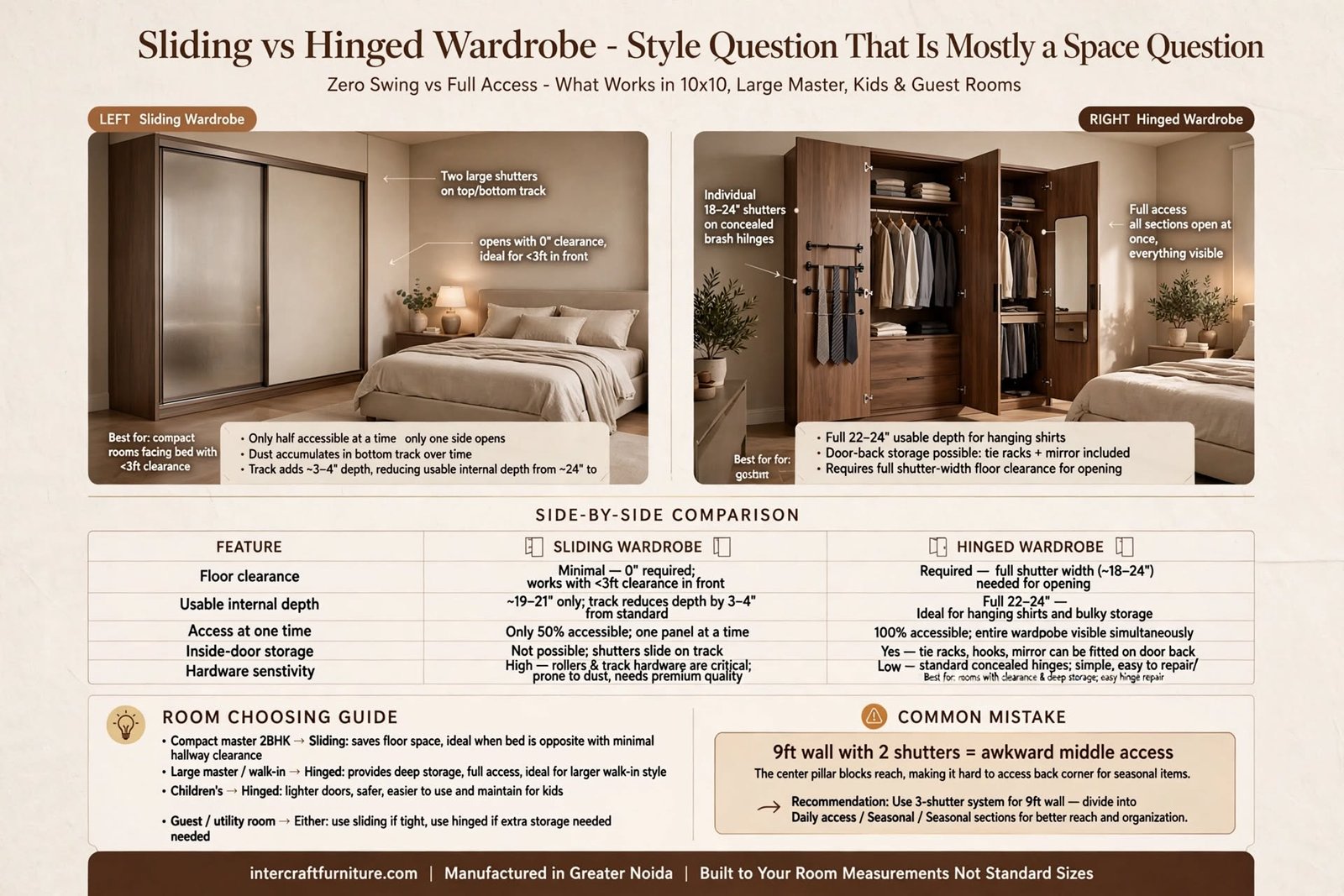
If your bedroom is compact, or the wardrobe faces the bed with less than about three feet of clearance, go sliding. If you have room to swing a door open and you want to see your entire wardrobe at one glance, go hinged. Everything below is the detail behind that rule.
How sliding wardrobes work
Sliding wardrobes run on a top or bottom track, with two or three shutters that pass in front of each other. Nothing projects into the room when you open them.
Where sliding wins
- Zero swing space. In a 10×10 bedroom where the bed sits close to the wardrobe wall, a hinged shutter simply cannot open fully. Sliding removes the problem entirely.
- Large uninterrupted surfaces. Wide shutters give you a clean canvas for mirrors, lacquered glass or full-height laminate panels.
- Fewer moving parts at eye level. No handles jutting out, which matters in narrow walkways.
Where sliding costs you
- You lose depth. The track adds roughly 3 to 4 inches to the wardrobe depth, so internal usable depth shrinks compared to a hinged unit on the same footprint.
- You can never open it all. With two shutters you only ever see half the wardrobe at a time. With three, two-thirds.
- Track maintenance. Dust and hair collect in bottom tracks. Good quality top-hung systems avoid most of this, but they need a strong ceiling-level support.
- Cost per running foot is usually higher, because the hardware carries the weight of a large shutter and cheap tracks fail fast.
How hinged wardrobes work
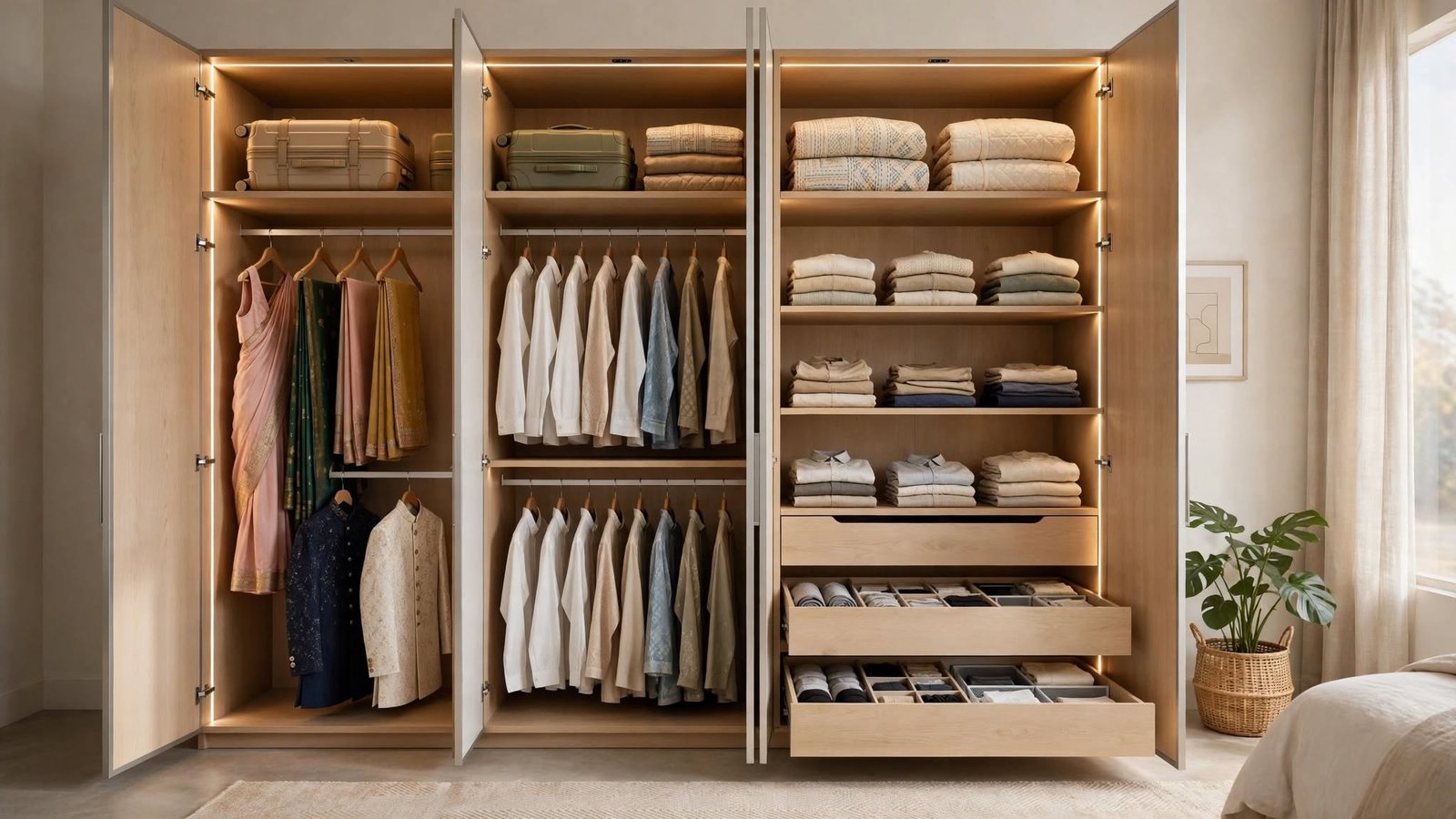
Hinged wardrobes use individual shutters on concealed hinges, typically 18 to 24 inches wide each. They are the traditional choice and still the more practical one in many rooms.
Where hinged wins
- Full access. Open every shutter and the whole interior is visible at once. For deep wardrobes and daily-use clothing, this matters more than people expect.
- Better internal depth. No track means the full carcass depth is usable — usually around 22 to 24 inches, enough to hang a shirt across without crushing shoulders.
- Door-back storage. You can mount accessory racks, tie holders and mirrors on the inside face of a hinged shutter. Impossible with sliding.
- Easier to repair. A failed hinge is a five-minute replacement. A failed track can mean dismantling the shutters.
Where hinged costs you
- Swing clearance. Each shutter needs its own width in free floor space in front of it.
- Alignment over time. Tall shutters can sag if the hinge quality is poor or the carcass is not plumb.
Side-by-side comparison
| Factor | Sliding | Hinged |
|---|---|---|
| Floor clearance needed | None | Full shutter width |
| Usable internal depth | Reduced by track | Full carcass depth |
| Access at one time | Half or two-thirds | Entire wardrobe |
| Inside-door storage | Not possible | Possible |
| Hardware sensitivity | High — track quality is critical | Moderate — hinge quality matters |
| Typical cost per running foot | Higher | Lower |
| Best suited to | Compact rooms, wide walls | Rooms with clearance, deep storage needs |
Choosing by room
Compact master bedroom in a 2BHK
Sliding, almost always. In most NCR apartment layouts the bed occupies the centre of the room and the wardrobe sits on the opposite wall. Measure the gap between the bed edge and the wardrobe face — if it is under three feet, hinged shutters will hit the bed.
Large master bedroom or walk-in
Hinged. You have the clearance, and full visibility of your clothing every morning is worth more than the aesthetic of a flush sliding panel.
Children’s bedroom
Hinged, with lighter shutters. Children pull hard on doors, and a sliding shutter that jumps its track is both a repair and a safety concern. Hinged shutters at a height they can reach work better.
Guest room or utility storage
Either — but if the room doubles as a study or storage space where furniture may move around, sliding keeps the circulation clear.
The decision most people get wrong
Buyers often pick sliding purely for looks, then discover that with two shutters covering a 9-foot wall, the middle of the wardrobe is awkward to reach and the section behind the parked shutter becomes long-term storage they rarely open. If you want sliding across a wide wall, plan a three-shutter system and put daily-use hanging in the sections you access most, with seasonal storage behind.
The other frequent mistake is under-specifying hardware. On a sliding wardrobe, the track carries the entire weight of a tall shutter thousands of times over its life. This is not the place to save money — a failed track is a far bigger problem than a failed hinge.
Frequently asked questions
Does a sliding wardrobe really reduce storage?
Slightly. The track mechanism eats into depth, so on an identical wall you get marginally less usable internal space than a hinged unit. In practice the difference is small, but if you are storing bulky items like suitcases or bedding it can matter.
Which lasts longer?
Both last a long time when the hardware is good. Hinged wardrobes are more forgiving of average hardware; sliding systems depend heavily on track quality and correct installation.
Can I mix both in one bedroom?
Yes, and it often works well. A sliding main wardrobe on the tight wall, plus a hinged tall unit or dresser on a wall with clearance, gives you the advantages of both.
What internal depth should I plan?
Around 22 to 24 inches for hanging clothes. Anything shallower and shirts will not hang square across the rod.
Planning your wardrobe
The right answer depends on your actual room dimensions, not on a general rule. Intercraft Furniture manufactures both sliding and hinged wardrobe systems in-house at our Greater Noida facility, built to your room measurements rather than to standard sizes. If you would like a site measurement and a layout recommendation for your bedroom, get in touch through intercraftfurniture.com.